

What does digital-ready policies mean?
“Policies (and legislative acts) are digital-ready if they enable smooth and digital by default policy implementation through best use of digital technologies and data."
Components and enabler of digital-ready policies:
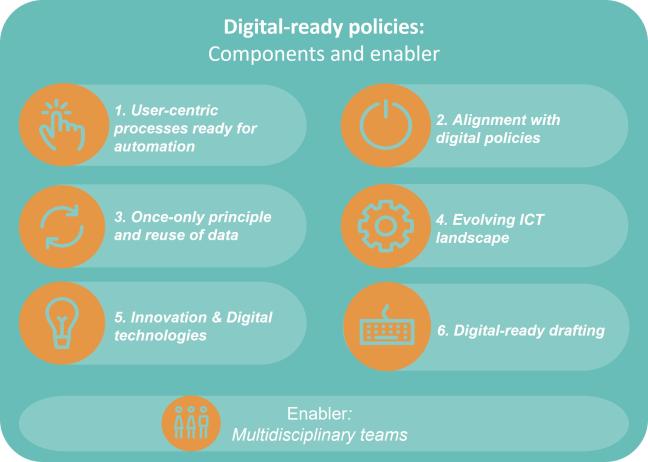
1. User-centric processes ready for automation
- Policies affect various business processes. These business processes will in many cases be supported by digital technologies by default.
- IT can be an enabler for simplification and automation for business processes to be partially or completely executed through digital technology.
- Analyse the business processes of the different stakeholders affected by the policy. Focus on user-centricity as this is also the guiding principle for the IT implementation.
2. Digital policies
- When designing the policy, it is imperative to assess the consistency and interaction with existing legislation and with on-going policy developments on digital topics (such as eIDAS, GDPR...).
- Assess the consistency of your future policy with International or European Standards.
- Consider the existing IT investments programmes (e.g. high capacity networks).
3. Once-only principle and reuse of data
- The Once-Only Principle should allow public administrations in Europe to reuse, or share, data and documents that people have already supplied, in a transparent and secure way. The Single Digital Gateway is one important instrument to implement the once-only principle, but every EU policy should contribute to it.
- Policymakers should know the data assets linked to their policies and aim to remove obstacles to sharing, combining and reusing these data assets.
- When it comes to collecting data, the first step should be to explore existing data within your organisation and public sector data made open by Member States and European Institutions in line with the ‘Open data directive’.
- Reusing concepts helps not only consistency but also reuse of data across sectors.
4. Evolving IT landscape
- When designing the policy options, policymakers should involve IT experts to analyse the capabilities provided by the existing IT landscape.
- Reusing existing ICT solutions could reduce costs and accelerate implementation. IT experts may consider the reuse of open source interoperable solutions available on Joinup, a collaborative platform created by the European Commission.
- To start with, contact your organisation’s IT unit for advice. It could also be useful to get in touch with the decentralised agencies managing IT systems for your policy and with your contacts in the Member States using these existing IT systems.
5. Innovation and technologies
- Digital technologies give opportunities to respond to old problems in new ways for better outcomes and provide more added value to citizens.
- A digital-ready policy which is designed in a forward-looking manner, (e.g. to allow for future expected changes in the further uptake or development of technology (such as the ‘Internet of Things’) will also potentially save future costs.
- Policymakers should consider the high costs of phasing-out IT-legacy systems without preventing innovation and new digital approaches to develop. They should also ensure to have the right level of digital skills and IT experts in the IT landscape where the policy will be implemented.
6. Digital-ready drafting
- Set out clear rules in the legislative act while keeping those rules future-proof to technical development.
- Consider the need for a clear governance for shared IT systems.
- Use simple, precise and concise wording - especially for the parts that are likely to be automated - the digital-ready terms are as clear as code.
- Reuse existing concepts from your policy domain and ensure alignment with those in related policy sectors thus ensuring interoperability.
- Check for fit-for-purpose compliance promoting tools.
- Consult the IT colleagues responsible on the deadlines: For example, avoid setting the date of entry into force right after bank holidays (e.g. 1 January).
- Consider the introduction experimentation clauses, as a legal basis for regulatory sandboxes.
Enabler: Finding the right multidisciplinary team
Last, but none the least, collaboration across policy areas is a must in order to reconcile different views, priorities and perspectives and to onboard the relevant expertise during policymaking.
When designing digital-ready policies, the multidisciplinary team supporting the interservice work should ideally include:
- Business architects.
- People with a good overview of the digital EU legislative landscape.
- Data experts.
- People with digital/IT knowledge – including security aspects.
- People with implementation experience.
- People with knowledge in innovative policymaking methods.
- Experts from standardisation organisations or industry.
- Data protection specialists.
Useful resources on digital-ready policymaking
Find below useful resources and insights into digital-ready policymaking best practices and principles.
Guidelines
|
Online courses |
Feel free to contribute!
Do not hesitate to contact us to share any thoughts and feedback. Or even better, become a member. And if you have a contribution, we would like to include it below!
